Δευτέρα 23 Απριλίου 2012

Τρίτη 10 Απριλίου 2012
Παρασκευή 6 Απριλίου 2012
The insecure economic world is back with us again, half a century after we thought we had made its return impossible

Good Friday 2012: when the line is crossed
The insecure economic world is back with us again, half a century after we thought we had made its return impossible
Editorial
The Guardian, Friday 6 April 2012
Article history
The Italian-American writer Pietro di Donato's short story Christ in Concrete first appeared in 1937, and was later expanded into a novel which became one of the most widely read books ever published in the United States. It is an only slightly fictionalised account of the life of his father, Geremio, a bricklayer who had died, trapped in setting concrete, in a construction accident in the 1920s. Like millions of other American workers in the interwar period, Geremio had no choice but to accept the daily risks of earning his living in an industry where safety regulations were either lacking or routinely violated, where wages could be and often were arbitrarily reduced, and where there was little or no security of employment.
Geremio rages against a world in which the forces which Di Donato calls "Job" and "Boss", allegories for a mindless capitalism which either cannot or will not count human costs on its balance sheet, seem to always prevail. "To rebel is to lose all of the very little," he reflects. "To be obedient is to choke. O dear Lord, guide my path." Geremio dies on a Good Friday, which for his son the writer cemented the idea that his father was in some sense following in the steps of Jesus. Although neither Jesus nor Geremio had willed his own death, Geremio had nevertheless risked his in a spirit of personal sacrifice that had as its ultimate model the Gospel story. Christ in Concrete shifted the American mood, and Geremio's death counts among those that have, to one extent or another, altered history.
"Jesus Christ" was reportedly the first thing John F Kennedy said when told of the fate of Thich Quang Duc, the monk who burned himself to death in June 1963 at a Saigon street corner to protest against the persecution of his fellow Buddhists by the Ngo Dinh Diem government. The monk's sacrifice, one American commented at the time, reduced not only his own body but also "the Diem experiment" to ashes. Five months later Diem's government fell and he himself was killed, in part because of a series of self-immolations that dramatised how completely he had lost the trust of the South Vietnamese people.
Such deaths are distinct from suicide attacks, in which one's life is given up as a means to the end of killing others. There is sacrifice in jihad, and indeed in warfare generally, but it is not in the same category as suicides such as those of Jan Palach in Czechoslovakia in 1969, of Mohamed Bouazizi in Tunisia in 2010, and perhaps of Tibetan monks in China today. These aim at changing minds, not at breaking other people's bodies. In them, sometimes the element of political protest is to the fore, sometimes personal desperation is more prominent. Either way, these extreme sacrifices should have served, but usually have not, as warnings to those in authority that they are in danger of crossing over a certain line, beyond which they will not even be able to secure acquiescence, let alone support.
"How do you expect me to make a living?" Bouazizi cried in front of the local governor's house. What was a question in Tunisia yesterday is a question across much of Europe today. The insecure economic world in which Geremio lived – and died – is back with us again, after a half century during which we thought we had made its return impossible. Our leaders, and those who influence them, are not malign. But they are inept, and they seem often to be uncaring.
Which brings us to Greece. Dimitris Christoulas took his own life because he could not bear the degradation which faced him personally, and, it may be inferred, because he also wanted to speak for the many other Greeks and many other Europeans suffering under a senseless austerity. The call for physical revenge in his suicide note is hardly Christ-like, yet on Good Friday it is the dimension of sacrifice that feels most relevant. He chose, in Geremio's words, "to lose all of the very little", in the hope of achieving something for others. We fail to heed him, and others like him, at our peril.
FOR THE BRUTAL ATTACK OF THE POLICE FORCES ON OUR COLLEAGUES AND THE INJURY OF THE PRESIDENT OF EFE

ANNOUNCEMENT – INDICTMENT
FOR THE BRUTAL ATTACK OF THE POLICE FORCES ON OUR COLLEAGUES AND THE INJURY OF THE PRESIDENT OF EFE
Athens 4/5/2012
The Union of Greek Photojournalists denounces the new brutal and unprovoked attack by the special police forces of MAT against colleagues who were covering yesterday’s rally in Syntagma square, as well as today’s demonstration. This time victim was the President of our Union, Marios Lolos, who is already hospitalized “for traumatic brain injury caused by strike with a police baton (skull fracture impressed) requiring surgical intervention”! We want to remind that this is not the first time that the President of EFE is becoming a target, moreover in the same way. In the 15th of December 2010 he was hit from behind on the head by a man of the MAT police forces, while doing his job, and the very next day our union in its announcement drew attention to the Ministers in charge “to follow through their responsibilities, because we are afraid that in the end we shall mourn victims”!
We emphasize the fact that for one more time information of the public becomes a target, despite assurances by the (former) Minister of Protection (?) of the Citizen to EFE’s representatives, in our meeting last July regarding similar incidents, that “the political and physical leadership of EL.AS. (Greek Police) is devoted to the protection of the democratic rights and treats the information vocation with the needed sensitivity and shall make every effort so that it can be exercised freely and unobstructed” (!!) nullifying these assurances.
The systematic and repeated attacks against the press workers, while on duty, that violate even fundamental human rights, can be considered far than random. Even in the most good faith, one could conclude that these attacks are consciously exercised by several circles in order to impose silencing of the free press with the also conscious attempt to terrorize the free press workers.
Moreover we see that there is no development in similar brutal attacks that took place previously, like the one against our colleague journalist Manolis Kypraiou, who suffered permanent disability and we also note that tens of named complaints from our colleagues and our Unions regarding the provocative and brutal behavior of the police forces remain unaddressed (like the one against our colleague Tatiana Bolari) following the usual procedure of archiving any sworn administrative inquiry.
After these incidents our Union will join the rest of the Unions and the Federations in our sector in Greece and abroad, in the effort to preserve the freedom of information and will stand in every way against actions that undermine the foundations of democracy and attempt to return us back into situations and regimes for which our people has heavily paid and will never be repeated in our country.
Τρίτη 3 Απριλίου 2012
Σάββατο 31 Μαρτίου 2012
PHOTOS FROM DEMONSTRATION- SPANISH EMBASSY OF ATHENS - 31-3-12


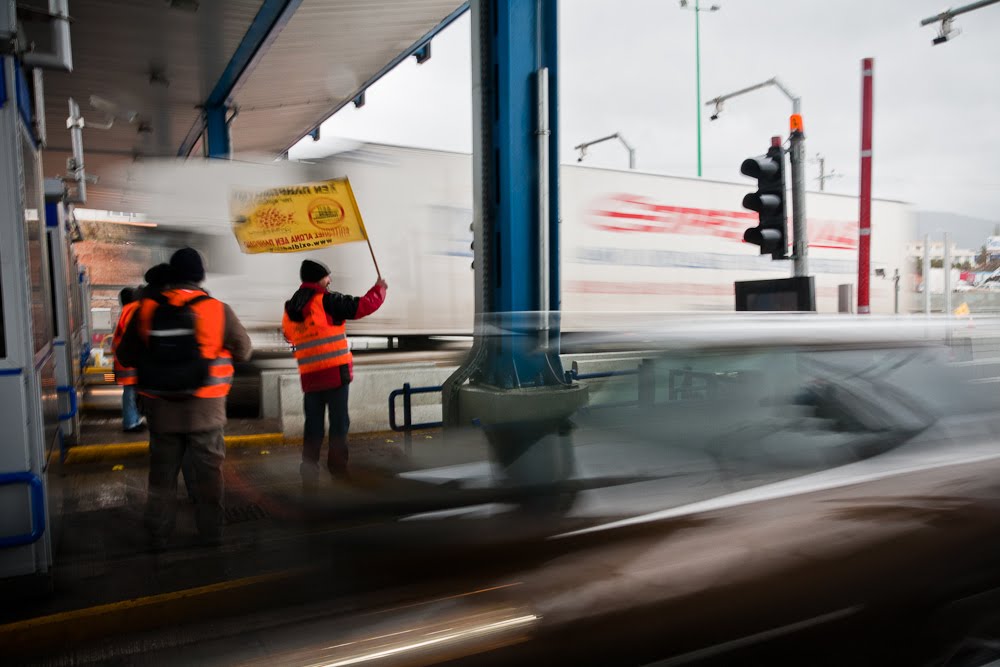
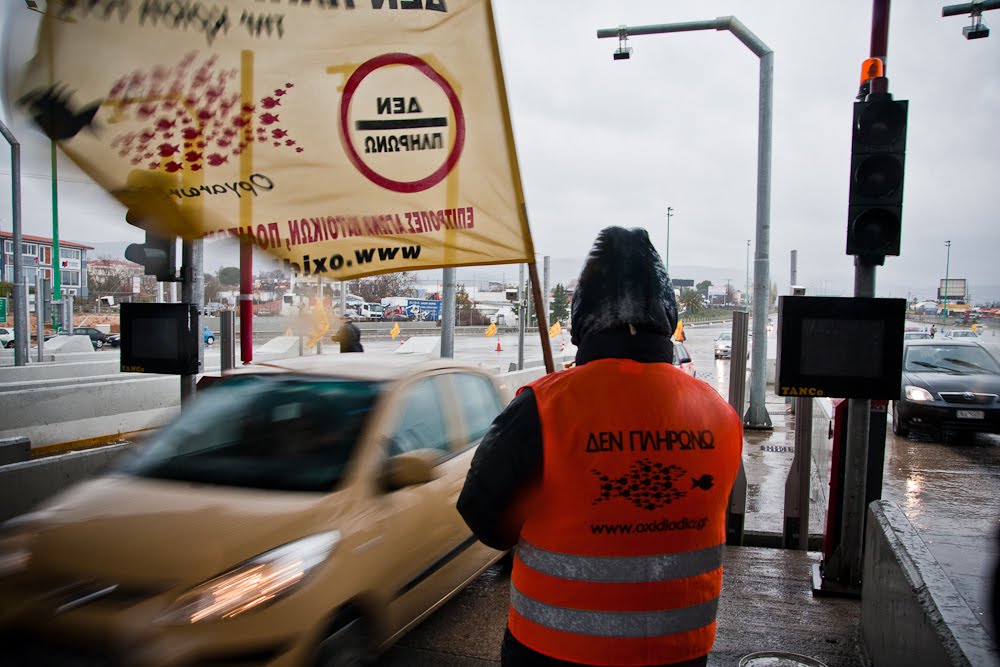
I DON'T PAY MOVEMENT WITH YELLOW FLAGS
Παρασκευή 30 Μαρτίου 2012
* SPAIN GENERAL STRIKE 29th OF MARCH
Source: Eagainst.com

A 24-hour general strike against labor reforms and austerity measures of the conservative government of Mariano Rachoi, was held today throughout Spain.
The protests began in the early morning hours. Holding red flags and banners that read “General Strike”, “No to labor reform”, and “Today we are fighting for the rights of our children”, groups of trade unionists took to the streets, while others stood at entrances of businesses in the central market of Madrid, and at key public transport stations.
Around 800.000 protested in Barcelona (according to El Pais), 200.000 in Madrid and 250.000 in Valencia. Clashes occurred in Barcelona and Malaga, while the police made extensive use of chemicals and attacked the protesters with plastic bullets. Nonetheless, the trade unions emphasize “the huge success” of the strike, noting that participation reached 77%. The Ministry of Interior announced that during the incidents in several cities in Spain 58 people were arrested, and nine were slightly injured.
Approximately one hundred demonstrations were held throughout the country. In Barcelona, two more evening demonstrations began, while in Madrid one more major march is expected.
The reform makes dismissals easier, and wage increases more difficult in line with inflation. It also reduces redundancy pay. The government announced that there will be no change in reforms. “On Friday Mariano Rajoy, the prime minister, is set to announce what even he describes as a “very, very austere budget” to reduce the deficit. According to El País, the EU is demanding cuts larger than those of Greece, Ireland or Portugal: “There is no comparable adjustment in [our] economic history,” says the paper” (Guardian) The trade union confederations CCOO (Workers Commissions) and UGT (General Workers Union) argue that these are the deepest cuts of workers’ rights after the change of regime in Spain. […]
READ / VIDEOS/ PHOTOS @ http://eagainst.com/articles/spain-general-strike-29nth-of-march/
SATURDAY 31ST OF MARCH, EVERYONE INFRONT OF THE SPANISH EMBASSY AT 6PM! WE ARE ALL SPANISH! WE ARE ALL XUBAN!

Συγκέντρωση διαμαρτυρίας και αλληλεγγύης στον ισπανικό λαό για την απεργία της 29ης Μαρτίου και για την κρατική καταστολή που υπέστη. Την μέρα της απεργίας εκατοντάδες χιλιάδες ισπανών πλημμύρισαν τους δρόμους και τις πλατείες όλων των πόλεων της χώρας ενάντια στις εργατικές μεταρρυθμίσεις και τα οικονομικά μέτρα. Η αστυνομία, απάντησε με άγρια, αλόγιστη βία στέλνοντας δεκάδες βαριά τραυματίες στο νοσοκομείο.
Ο Xuban, 19χρονος φοιτητής από την Βιτόρια (χώρα των Βάσκων) βρίσκεται σε κρίσιμη κατάσταση με εγκεφαλική βλάβη από πλαστικές σφαίρες στο κεφάλι.
Διονυσίου Αεροπαγίτου 21,πλησίον σταθμού μετρό Aκρόπολης, με Ισπανικές σημαίες,τύμπανα,σφυρίχτρες.
[eng]
SATURDAY 31ST OF MARCH, EVERYONE INFRONT OF THE SPANISH EMBASSY AT 6PM! WE ARE ALL SPANISH! WE ARE ALL XUBAN!
[esp]
EL SABADO 31 DE MARZO TODOS FRENTE A LA EMBAJADA DE ESPAÑA A LAS 6 DE LA TARDE! TODOS SOMOS ESPAÑOLES! TODOS SOMOS XUBAN!
Concentracion/Rally in protest and solidarity with the Spanish people for the general strike of the 29th of March and the police repression. The day of the strike hundreds of thousands of people flooded the streets and squares of all the cities of the country, against the labour reforms and austerity measures. The police responded with violence, leaving dozens severely injured and hospitalized. Xuban, a 19-year-old student in Victoria/Gasteix is in a critical state with interior bleeding after receiving a rubber bullet to the head.
Dionisiou Aeropagitou 21, near the metro station Acrópolis, with Spanish flags, drums and wistles...
Share the event!
[esp]
EL SABADO 31 DE MARZO TODOS FRENTE A LA EMBAJADA DE ESPAÑA A LAS 6 DE LA TARDE! TODOS SOMOS ESPAÑOLES! TODOS SOMOS XUBAN!
Concentración en protesta y solidaridad con el pueblo español por la huelga del 29 Marzo y por la represión policial que recibió. El día de la huelga centenares de miles de personas inundaron las calles y las plazas en todas las ciudades del país, contra las reformas laborales y las medidas económicas. La policía respondió con violencia, dejando decenas de heridos gravemente en el hospital. Xuban, estudiante de Vitoria/Gasteix de 19 años está en estado crítico con derrame cerebral por un pelotazo en la cabeza.
Dionisiou Aeropagitou 21, cerca de la estación del metro Acrópolis, con banderas Españolas, tambores, silvatos....
Defundid!
Σάββατο 24 Μαρτίου 2012
24-03-2012 Athens,Riot police attack peaceful protesters
24-03-2012 Athens,today,the illegal,not elected Greek government ,in a state of panic,gathered 4000 cops in the cetre of Athens to prevent the public outcry against their policies,which they feared it was going to burst,in the students' parade for the celebration of the national celebration of the 25th of March.The riot police brutally attacked a group of teachers and university students who were trying to protest and arrested 20 of them.The Greek people will not give up.It is either us or them!
ΑΘΗΝΑ 24 ΜΑΡΤΙΟΥ 2012,Η ΑΣΤΥΝΟΜΙΑ ΕΠΙΤΙΘΕΤΑΙ ΣΤΟΝ ΚΟΣΜΟ ΠΟΥ ΦΩΝΑΖΕ ΑΝΤΙΜΝΗΜΟΝΙΑΚΑ ΣΥΝΘΗΜΑΤΑ ΚΑΙ ΠΡΟΣΠΑΘΟΥΣΕ ΝΑ ΠΡΟΣΕΓΓΙΣΕΙ ΟΠΤΙΚΑ ΤΗΝ ΜΑΘΗΤΙΚΗ ΠΑΡΕΛΑΣΗ.
Τετάρτη 21 Μαρτίου 2012

Παρασκευή 16 Μαρτίου 2012
Κυριακή 11 Μαρτίου 2012

THE POTATO MOVEMENT IN GREECE
Global Occupation, Greece, Information, Video Add comments
Mar 112012http://www.blogger.com/img/blank.gif
http://99getsmart.com/?p=2666
By Eva I. Aten, Greek Salad
The consumers take the power!
I have written before how strange it is that the prices are so high in the supermarkets in Greece, often significantly higher than in other countries. If we look at the prices in relation to the wages as well, it’s really very, very expensive here!
The potato price/kg is about 0,80 €. This price is very high considering that the potato producers get about 0,15 €/kg from the suppliers. As the people in Greece don’t have a lot of money the sales of potatoes has gone down a lot the last year.
The 4th of February potato producers were giving away tones of potatoes for free in Thessaloniki. They thought it was better then to leave them rottening in their store rooms.
That’s when the idea of “The Potato Movement” was born! The producers are selling potatoes in sacks of 10, 20 or 30 kilos directly to the consumers. The price is 0,25-0,35 €/kg and this way the people can purchase more potatoes and the producers are getting a good profit. [...]
Πέμπτη 8 Μαρτίου 2012
South Africa Protesters March Against Tolls Roads, Labor Brokering

Tens of thousands of people in South Africa took part in protests Wednesday against so-called e-tolling on highways and to demand that labor brokers be outlawed.
The protests were called by the powerful Congress of South African Trade Unions, or COSATU, and have impacted transport as well as schools and health facilities.
COSATU has been at the forefront of a demand made by many organizations that the Gauteng provincial government abandon a plan to introduce an e-tolling system on highways. Zwelinzima Vavi, COSATU general secretary said earlier this week motorists should refuse to pay the tolls.
"We will be encouraging motorists to drive through the tolls without paying," said Vavi.
The new system will make use of structures positioned over the highways armed with cameras and electronic reading devices. Motorists can purchase discounted toll fees in advance, loaded onto electronic tags, and the fees will be automatically deducted as they pass under the structure. If they fail to do so, their vehicle registration number will be noted, and they will receive a bill in the mail.
Similar tolling systems are also expected to be introduced in other provinces. Last month, in response to protests against the tolls, the finance minister announced the government would subsidize the cost of the $2.5-billion operating system by $725 million. But this did not appease COSATU.
The system is defended by Professor Roelof Botha of the Gordon Institute of Business Science. He says a study he did indicated that the tolling system would benefit road users because of less traffic congestion and save both time and money. He also said that contrary to many people's perceptions, the tolls will not add to the financial burden of the poor, because public transport vehicles will be exempt, and 94 percent of the tolls will be paid by the wealthiest users.
COSATU is also demanding that the government outlaw labor brokers -- people who employ workers, hire them out to companies, then take a cut of the employees' wages. The unions say the brokers undermine the government’s policy of decent work because many workers have no security of tenure and do not receive heath care and pension benefits. They are also not members of trade unions.
A female protester told the eNews Channel that she has worked for a labor broker for 10 years, and that her salary is so low she finds it difficult to feed her children.
"I am here because I am working for labor brokers for 10 years, and I have children going to school and this money is not [enough] because I can’t buy for, because I [am paid] only R300 [$40] a week in post office, so I can’t [manage]," she said.
Labor brokers became common in the 1990s when stringent new labor laws greatly increased the red-tape involved in hiring and firing workers. The new laws particularly affected small- and medium-sized businesses, which found the complex red tape required to manage personnel increasingly time-consuming and costly.
The government proposes to regulate labor brokers, to ensure that people employed by brokers have fair and equitable conditions of employment.
South African protesters demand end to road tolls
Thousands of people have gathered in Johannesburg to protest against the cost http://www.blogger.com/img/blank.gifof toll roads linking the city with the capital Pretoria.
The protests are also directed against 'labour-brokering' - when agencies hire workers on short-term contracts.
The government upgraded existing motorways in and around Johannesburg for the 2010 football World Cup. It says the work was not free of cost, and it now wants the electronic toll road system to retrospectively finance them.
Protesters have been explaining why they are opposed to the charges.
see the video
bbc
Τετάρτη 7 Μαρτίου 2012

Τρίτη 6 Μαρτίου 2012
G8 Moving to Camp David! Protestors claim victory, to continue plans to march on May 19th

Κυριακή 4 Μαρτίου 2012
VIDEO SOLIDARITY TO THE STEEL WORKERS OF GREEK STEEL MILL WHO ARE ON STRIKE FOR 125 DAYS
PHOTOS FROM 3/3/2012 - SOLIDARITY TO THE STEEL WORKERS OF 'XALIVOURGIA' WHO ARE ON STRIKE FOR 125th DAY


Σάββατο 3 Μαρτίου 2012


Πέμπτη 1 Μαρτίου 2012
I Don't Pay Movement-About us

The ‘DEN PLIRONO’ movement is born from the current social needs and constitutes a political movement of disobedience and resistance. It is flesh from the flesh of all exploited social layers and fights for two years, vindicating the social character of public goods. Fundamental political place and axis of action of our movement constitutes freeing of charge and access to all people, in all social goods that are essential for his decent existence. We fightingly claim free of charge education, health, streets, public spaces, Means of Public Transport, Water, Electricity, all natural goods (eg beaches, forests, air), and each good of social character for each person, Greek or immigrant.
Τρίτη 28 Φεβρουαρίου 2012


Δευτέρα 31 Ιανουαρίου 2011
ΠΑΛΕΥΟΝΤΑΣ ΓΙΑ ΔΩΡΕΑΝ ΚΑΙ ΙΣΗ ΥΓΕΙΑ ΓΙΑ ΟΛΟ ΤΟ ΛΑΟ!
 Όταν ο αγώνας για ελεύθερη πρόσβαση στην Υγεία ξεκινούσε με πρωτοπόρο το Κίνημα Δεν Πληρώνω.
Δείτε το βίντεο από τις πρώτες δράσεις ενάντια στο χαράτσι των 5 ευρώ.
Λαικό Νοσοκομείο πριν 4 χρόνια, 31-1-11